The Game of Attention
How to create an attention flywheel for your business

Happy Saturday, Elvis here.
I've sent over 500,000 cold emails.
I've gone viral on X and hit the front page of Reddit.
I've landed clients in Forbes, WSJ and every tier 1 media.
But for years, I treated these as completely separate things. Running PressPulse agency was PR. Scaling PressPulse with cold email was growth — something I've written about in this very newsletter. Building my personal brand on X was social media. Growing on Reddit was its own beast.
Different playbooks. Different skills. Different worlds.
Then a realization hit me last year that changed how I think about all of them.
The Realization
I was watching James Donaldson, most know him as MrBeast, talk about how he spent years studying attention. Analyzing every second of his videos. Obsessing over retention graphs. Treating every frame like it had to earn the right to exist.
And it hit me: that applies way beyond just youtube - that's the whole game.
That viewer who moved on from his YT video, that person who scrolling past my tweet, that prospect deleting your cold email, that journalist ignoring your pitch—they're all the same person doing the same thing—protecting their attention.
Because at its core, marketing is about this one simple skill:
Earning attention - from people who’re trained to ignore almost everything.
If you are like me, once you see this, you can’t unsee it.
PR isn't about relationships anymore. Cold email isn't about just deliverability. Social media isn't about algorithms.
Everything becomes one game, and once you learn one, you can play every other game.
Let me show you what I did this year:
Example 1: X → Reddit → Journalist
I posted a script on X that helps people with their Claude Code limits. It went viral — solid engagement, 340k impressions. (I already wrote about the psychology of this previously on how I made 5 viral tweets in a single day)
Then I did something stupid-obvious: screenshotted the viral tweet and posted it to r/ClaudeAI, with zero explanation, just the screenshot and the fact this is trending on X.
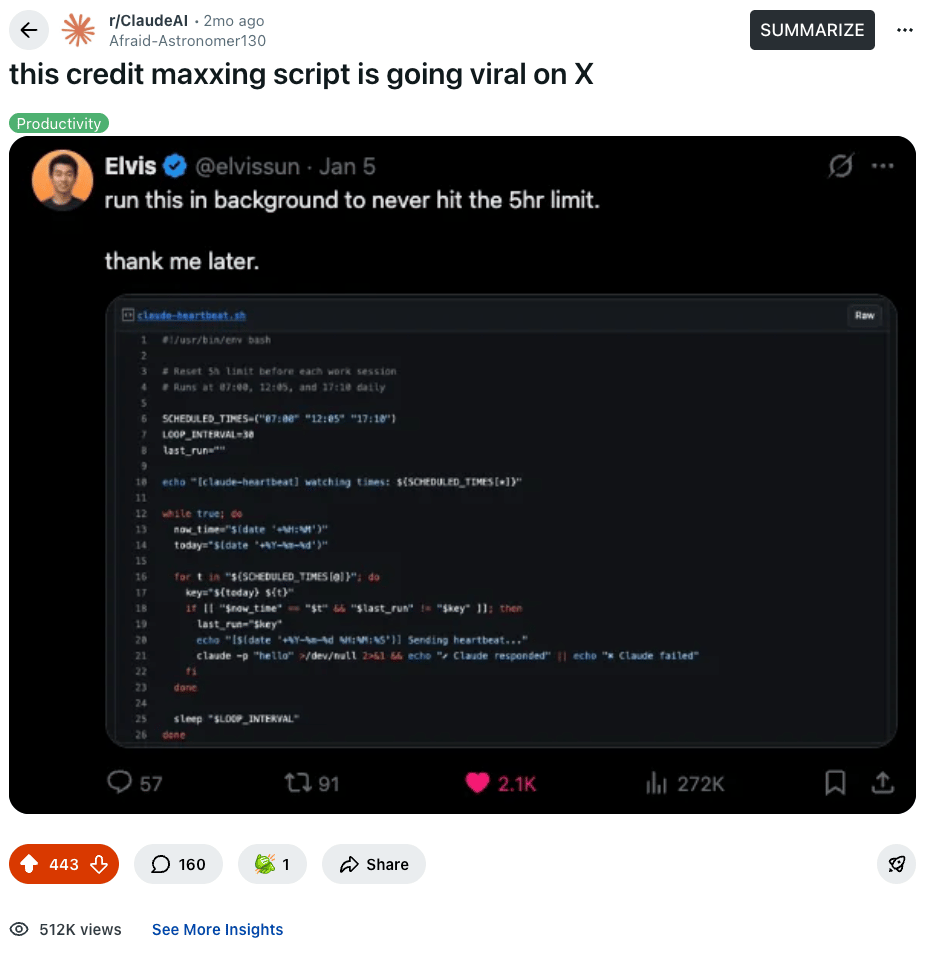
Result: 512,000 views on Reddit. Even more than the original tweet lol.
Why? Because the screenshot already had social proof baked in. The Reddit audience saw the engagement numbers before they even read what the script does. That signals: other people already found this valuable. The decision to engage is half-made before they finish the title.
Same content. Two viral moments. 10 seconds extra work.
But it didn’t stop there.
A journalist retweeted my hack. I sent a DM that day to follow up, which turned into a warm relationship built for future pitches, simply by showing up with something that already proved it was worth their attention.
Example 2: X → Mashable feature and 2x DR91 backlinks
Then later in January, when someone launched Moltbook, tech Twitter lost its mind. Everyone was posting about it. I saw an angle nobody was talking about: the prompt injection risk.
I posted a short comment under the announcement, it racked up 100 likes. 10.8k views.
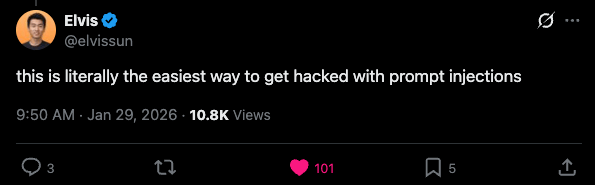
That early traction told me something: people cared about this.
So I took that proven attention to another channel - PR. Wrote up a worst-case attack scenario with my best security tips, found 9 journalists who just covered this topic using Medialyst, and pitched it to journalists before anyone covered it.
3 days after my initial X comment, this quote I sent showed up on Mashable, with two backlinks to both my personal site and my business site that I didn’t even ask for.
The idea that got traction on X worked on journalists. Same psychology. Same attention triggers. Different channel.
The End Game: Product-Driven Attention Flywheel
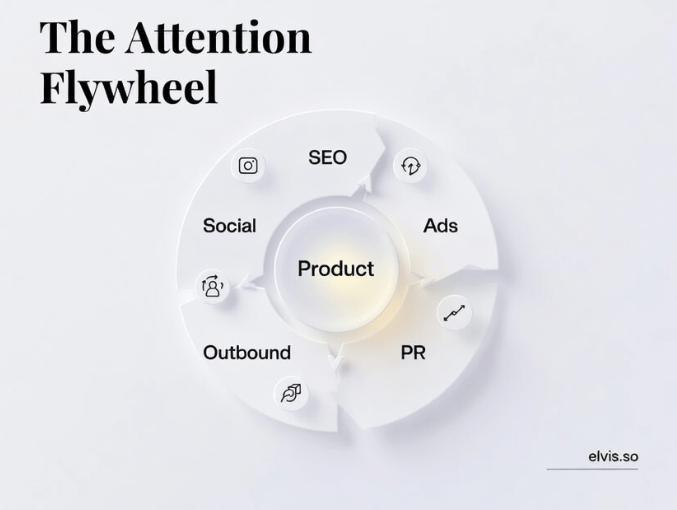
Those examples above? Baby steps.
Cross-channel amplification is powerful, but it's still manual — you create something, then figure out how to spread it. The most powerful flywheels are product-driven. The product itself generates the attention.
Here’s the most fascinating one I found recently:
Polymarket detects breaking news before any newsrooms do — because traders pile into markets the second news breaks. They use that signal to be first on every story. Dozens of posts and millions of views daily, entirely automated probably.
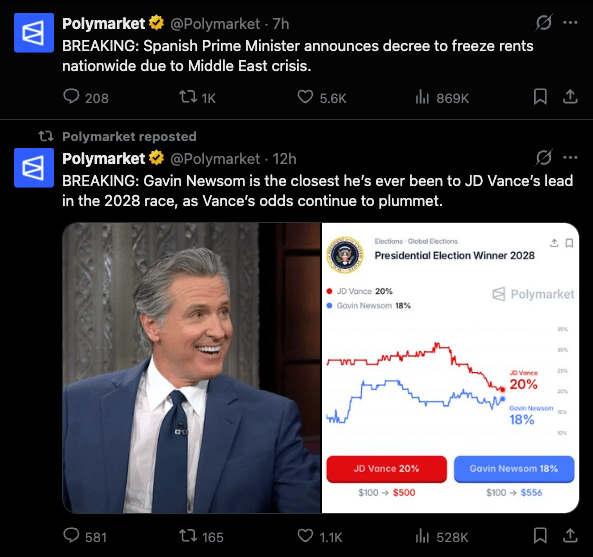
Product moat becomes distribution moat. Genius.
Levelsio's PhotoAI is another example, it’s inherently viral — stunning AI-generated photos easily spread everywhere. Every share is free marketing. The product spreads itself.
I did a mini version of this with ismypitchshit.com — a PR stunt free tool that turned into marketing assets distributed in other channels. (more on that story here)
This year I'm putting it into practice. One unified GTM machine — newsletters, X, LinkedIn, PR, outbound, SEO, ads. Everything feeding everything else. Stay tuned for more marketing experiments.
So what now?
PR people think they're in PR. Cold emailers think they're in sales. Social media managers think they're in content.
They're all in the same business: the business of earning attention.
Next time you write anything — cold email, tweet, blog, pitch — ask yourself: "Would I stop scrolling for this?"
If not, neither will they.
Elvis
p.s. If you've got something newsworthy and want to get that story in front of journalists, I’m building Medialyst that helps you find the right ones in seconds. Founder pricing ends April 2nd.